The Fraudkuna of marketing agencies in Indonesia
Across the many years I‘ve worked writing for some of the world’s best brands — and collaborating with folks from all around APAC — I can say I‘ve had it good. Most of my bosses and colleagues were rational and delightful to work with. (Maybe it was because I spent most of my time freelancing, or contributing as an independent contractor).
But this year, I thought I would try something new. I joined an Indonesian agency as the Head of Content Strategy. On paper it looked awesome.
“Ownership over social, blogs, video, and whatever other channels make sense for what we're trying to achieve.”
“You’ll be in charge of building your own dream team.”
“The freedom to test new formats, experiment with different approaches, and find what clicks with our audience.”
But I should’ve known better. After all, there‘s a reason why, throughout an entire decade of work, I’ve mostly avoided working with Indonesian agencies. My brief encounters with them always revealed shoddy internal processes and nonexistent work life balance. The tragic case of Mita the copywriter, who passed away after working for over 30 hours with no sleep, has always been in the back of my mind since I first read about it in 2013. Not only that: the founder of this particular agency is a YCombinator alumni, and he has also been on the Forbes 30 under 30 list.
(If those aren’t the biggest red flags).
But I told myself: How bad can it be? And against my better judgment, I convinced myself to commute back and forth to Jakarta every week because I wanted to be there for a fledgling team.
I lasted about six or seven weeks before giving up. It was cathartic and I enjoy my newfound freedom, and my lovely Lebaran vacation. But two days ago, this particular agency posted a reel on Instagram that had my face in it! This despite the fact that I officially resigned and my last day was in mid-March. So I decided to write this post to memorialize the terrible experience with this Fraudkuna agency and explain why I left (after all, I did promise to write about it).

Empty promises to potential clients
I don‘t know what it is about the startup world that makes it so rife with scammers. Is it because the dark triad of personality traits is just rewarded that heavily there?
Maybe it‘s my Zillenial idealism, but I don’t like working at a company that lies blatantly to sell things >:(
This particular agency marketed itself as if it had dedicated account managers, performance marketers, designers, and directors for every account. In the content we published — videos, landing pages, etc. — employees were portrayed as different positions from their actual roles, all to convince potential clients that they’d be in the capable hands of an ultra-experienced team.
Working at this particular agency demanded that we swallowed the lies everyday, pretending things were fine and dandy. Like Geto downing curses that tasted of wet socks and vomit.

It was gross.
Also, a lack of integrity causes direct operational consequences. When you promise clients more than you can deliver, someone has to fill the gap. This manifested as employees staying up at obscene hours to meet impossible deadlines, hours and hours of wasted footage and unused images, and constant exhaustion.
Imitation masked as innovation
Tech bros love generative AI because at their heart they‘re deeply insecure, always chasing external validation (like Homelander in the latest (final!) season of The Boys).

The process of learning a new skill necessitates failure, which implies humiliation — a worst nightmare for many founders. Generative AI lets them skip all of that.
During my time at this particular agency, I was horrified to open vibe-coded landing pages that were exact copies of other websites. Friends were berated for not being able to recreate another agency’s visual assets exactly. I was spammed with links of videos from other, better, more successful agencies and told to make something similar.
Pretty ironic considering the founders extolled the importance of “adapting playbooks for the local/target market” instead of “copypasting strategies”.
I think that for a lot of tech bros, their desire to feel intelligent transforms them over time into Gollum-esque monstrosities — ever reaching for lovely things they cannot possess. Ugh, grabby, spindly hands! The stench of insecurity!

They have very little self-awareness over how unappealing they are to people outside of their circles; how pathetic they look. Sadly, they surround themselves with yes men who assuage their fragile egos while robbing them out of house and home.
Case in point: the very sad suicide of much-beloved Zappos CEO Tony Hsieh, who was driven deeper and deeper into an unhealthy mental state due to a close circle of enablers.
In comparison to many of my colleagues, I was reticent and unwilling to fawn. I critiqued often and pointed out what I felt were lapses in judgment. I sensed this harmed my reputation, but what can I say? For many folks, a beautiful lie is preferable to the hideous truth.
(The founder of this particular agency is a tech bro).
Promises of a team never materialized
Even before officially joining this particular agency, I made it clear: to create great content, I‘d need a dedicated team. When I raised this during the screening call, it was taken lightly — dismissed with a blasé, ”Oh, we have people for that. You won‘t need to worry.”
The word “people” implies plural: a graphic designer, a videographer, a motion editor, a social media manager. Lo and behold — upon joining, I found not even one person dedicated to internal content.
The team I was promised? I was tasked with building it from scratch. Normally this wouldn’t be a problem. In my second or third week or so, I outlined my needs in terms of man-hours and we reached a consensus (or so I thought): we’d definitely need to hire at least one videographer, one video editor, and a graphic designer, in addition to a content manager. But somewhere along the way, the conversation was tabled and I was redirected to Upwork instead. This despite ambitious plans for a podcast, organic founder-led content, organic brand content, and a pipeline of video ads each stretching up to four minutes long.
Absurd questions I had to field:
“Do we really need an internal team?”
“Can‘t we just find freelancers on Upwork?”
“How about we just block out a few hours a day from the designers to do internal content, so that they can continue doing client-facing work as well?”
This experience solidified my belief that a company that lies to clients will lie to their staff. Conversely, a company that treats staff like shit will also treat their clients like shit.
Obscene levels of cognitive dissonance
During my brief tenure at this particular agency, one of the key differentiators it tried to claim in marketing content was: “We don’t chase vanity metrics in the dashboard. We look at the data that actually matters.”
Yet, at the same time, the founders were crowing about successfully growing the headcount to 100 people in under two years. This was, they reasoned, a super mega awesome proof point.
Guys. Headcount growth on its own is literally a vanity metric. It says nothing about whether people stay, whether leadership is stable, or whether the organization functions well enough to retain the people it worked to recruit.
In the six weeks I was there, the performance marketing team — tasked with setting up and managing ad campaigns — shrunk from seven people to four. When I had a one-on-one conversation with a colleague, I was shocked to discover that they had been there, more often than not, for less than six months.
Masquerading as an “AI native” agency
I’ll give an inch: AI can have a place in legitimate agencies to speed up research, draft for reviews, and process data faster. But shoving buckets of client briefs and data into Claude and generating a 100-page AI slop report is… not a good use of AI.
First, Claude, ChatGPT, all of the popular LLMS — hallucinate a fck ton. That is something that we actually need to reckon with. I‘ve seen countless variations of Claude pitifully apologizing: “You’re right. You told me to do X, and I did Y.” Look up “Claude hallucination” on Twitter and you‘ll have enough anecdotes to read for weeks.
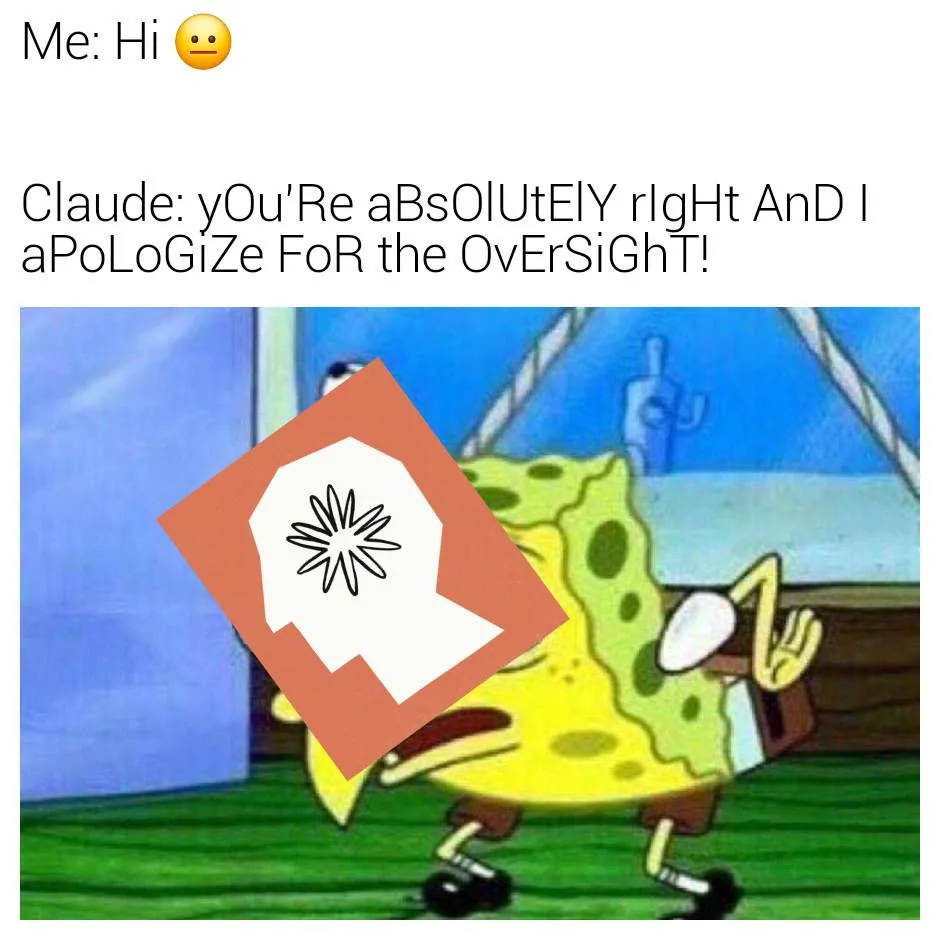
Second, it is a bald-faced lie to tell clients you are AI-native when all you are doing is launching a bajillion Claude chats and Clawbots to parse client info.
Third, is it not terrifying to build your entire agency operations on someone else’s paywalled LLM? When I raised this as a concern, I was once again dismissed. “We can switch to another model,” they said. “And if it goes down we can still work without AI, we’re humans!” Yet, simultaneously, they were revising their processes to incorporate Claude at every stage of the client process, from discovery to onboarding to strategy to execution.
(Naturally, I was considered the debbie downer for pointing this out).
Employees drowning in worthless noise and slop
Real productivity is created by leaders who know exactly what each member of their team is capable of and how to stitch individual strengths and weaknesses together. When that cornerstone is missing, the team shares confusion rather than ownership.
Meetings scheduled at 10pm. Daily alignment calls from 8 to 9 am. Check-ins and hours-long meetings that consume precious working time. Weekend café sessions with laptops (and Claude!) open, all framed as something positive. “AI bootcamps“ where folks spent the night at the COO‘s home. Group chats on fire at all hours of the day. Briefs that came in near midnight; last minute changes to content already produced. Tiktoks glorifying the after-hour work grind.
Noise — just constant, screeching, disgusting noise.
The law of equivalent exchange means that something cannot come from nothing. Shutting your eyes to the pain inflicted on your staff doesn’t make it go away.
Yeah, that room is damn loud. But none of that is evidence of solid work. A team with functional output does not need that many touchpoints.
I can’t help but feel that, as leaders, these guys are using their position of relative authority to Stockholm syndrome their employees into going above and beyond for work — and indirectly grooming their employees into believing that this is good, healthy, noble, and gratifying.
Rooms full of naive managers

For solid work to be achieved — whether AI is involved or not — the manager of any given team must be more qualified than the sum of at least half of its parts. If they aren’t, they will never be able to guide the team towards the desired state.
This is why non-coders who use Claude Code, Codex, etc. end up with major security vulnerabilities (e.g., endpoints exposed and unauthenticated), over-engineered slop, and major technical debt. It’s a case of the blind leading the blind. If you don’t know how to code, you’d never know that the codebase you’re working with is shit?
Unfortunately, at this particular agency, the managers of the enterprise teams were not more qualified. Naive managers with minimal copywriting, design, paid ads, and account management experience were made responsible for end-to-end marketing and sales campaigns. The absurdity of it all!
And because these managers had so little understanding of the field, the teams and processes they were building completely fell apart. They used Claude as a crutch to mask their inexperience, pushing back on actual specialists with AI-generated suggestions that lacked nuance and cultural context. When things didn’t go as planned, the specialists — most of whom had just joined — were booted.
The pattern was like this: an individual was hired after multiple online and offline interviews, plus a case study assignment. Upon joining, they‘d get thrown into real client work after a minimal onboarding period. As they attempted to integrate themselves into the team, they would get “challenged“ by inexperienced managers relying on Claude-generated suggestions.
As they struggled to meet unrealistic demands and cut through the fog of AI psychosis with their experience, leadership would meet and conclude a lack of fit — oh! the hiring process was not rigorous enough. The individual would then get “cut” and left without employment, and the recruitment process would get longer and more demanding. Self-recursion strikes again!
No one up top bothers to ask if the environment is the variable. Whether concrete internal processes or actually competent leaders might have produced a different outcome.
After all, questioning the environment they’ve built would require entertaining the idea that they did something wrong, and we’ve already established that that is nigh impossible for tech bros.
One actual quote from one of the founders: “Yeah, we realized we don‘t fit well with agency people. What we‘re learning is that we need to make the hiring process even more strict. We need to find builders like us.”
LOL.
Fragile egos on full display
I asked leadership whether they had concerns about the high turnover in certain departments. First, they tried to Joo Dee me:

Then, when I pushed further, they tried to make themselves out as noble heroes. Between the lines, their argument was: “Our team did shitty work even though we tried so hard to give them the support they needed. But we, as leaders, took the fall and apologized to the clients who were HURLING abuse at us“.
What a way to build morale in the internal team: point fingers at individual members to squirm out of accountability.
If a leader encounters such a situation, my hope is that they’d be able to take accountability for their oversight, then return to their team member and give concrete, objective critiques that allows them to improve. But I guess it’s easier to get emotional than to actually string together cohesive, thoughtful, and edifying feedback.
The breaking point that caused me to call it quits at this particular agency was when my direct manager asked: “Did you put your whole heart into this?” and “I don’t know how to describe what’s off about it; it just doesn’t feel impressive to me.”
Now all of China knows you’re a fraud

A well-run agency delivers what it promises. It defines roles before filling them and gives feedback that is specific enough to act on. It does not ask employees to maintain a fiction on behalf of leadership or treat people’s time as a buffer for poor planning. Burning out and having your commitment questioned should never be part of a work experience.
If you’re reading this and it hurts your ego, I hope you get help.